
Consisting of the sets of Invasion, Planeshift and Apocalypse, Invasion Block Constructed (IBC) decks are mostly three or more colors playing as conventional aggro, “tempo”, midrange or control archetypes. The decks really don’t have “synergy” as seen in modern card design; I think only Domain decks really look to assemble several cards (most of them being Basic lands) in play to build a so-called synergy. While I played during the era, I did not play too much Block Constructed beyond a few local events and one Grand Prix (though, I found myself building rogue decks quite a bit at the end of the format). Thinking back on the format, I think it is a great lower-complexity example of early Magic: the Gathering gameplay (that is after the Reserved List but still oldframe), and it features an early example of simple designs offering rich gameplay:
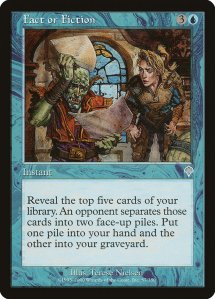
Fact or Fiction was a period favorite of many players (especially those enjoying Counterspell and related spells) that defines the format: players have to be able to win a game with less-efficient-than-modern-design (by *quite* a bit) cards through an avalanche of card advantage. Most “playable” cards cost at least 2-mana, but the best cards (interactive or otherwise) are often 4 or 5 mana; meaning any effective spells from 1-2 mana can potentially create a huge advantage. I want to start with some tried-and-true lists from the year 2001 Grand Prix and then update to tune them (or swap lists) to compete with one another.
Picking Four Decks Across the IBC Spectrum
I took some time to research decks that made Top 8 in Grand Prix during the IBC season, and came up with 2 differing styles of Control decks, a Midrange deck, an aggressive Tempo deck to try as a group of decks to give a good sampling of the format (and a showcase a good variety of colors to be played).
Decks with efficient 2-mana threats pressure to end the game (especially when backed by direct damage spells or haste creatures). A strong set of answers (some of which draw a card or better!) and straight card advantage spells threaten to grind aggressive decks out of proactive cards. The color-matters/multicolor-matters theme of IBC also threatens to exploit some color combinations from Turn 2 onward.
Some thoughts on matchups follows each deck list picture (which is linked to Moxfield.com to read card details if necessary). I am going to try to bring in each sideboard card in at least one of the matchups to better attempt to understand the reasoning behind their inclusions!
Deck 1: 5-Color Control (“Dark Domain”)
Kai Budde – Grand Prix London 2001
Hall-of-Famer Kai Budde’s testing team came to Grand Prix London with a unique take on the 5-Color “Domain” strategy that looks to assemble all five basic land types: punish the decks with 12 nonbasic lands with Destructive Flow and rely on a *single* Ordered Migration or Goblin Trenches to win Game 1. I do not recall if I played this version of Domain but am very excited to learn how to navigate this list to victory over many turns of careful play.
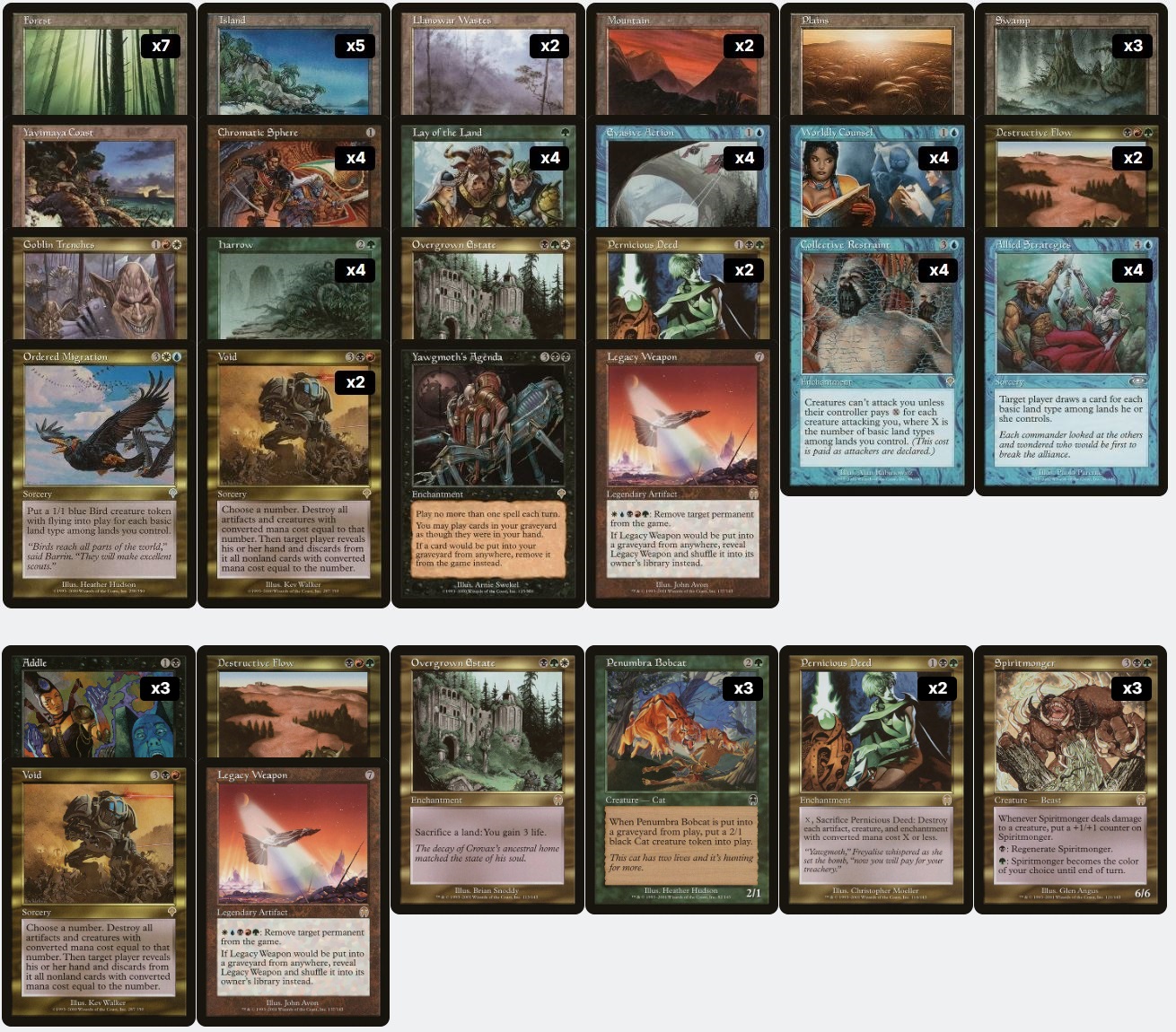
It’s been a long while since I’ve played this format, but I recall that the Domain deck play patterns were not intuitive. With a low number of win conditions and many specialized spells, the deck needs to conserve its resources for the right moments while surviving to assemble its expensive but powerful late game spells. I guess that against the three chosen opponents, Pernicious Deed has important application (where it would not be as valuable against Blue-White-Black or the Domain mirror match).
Versus UWR
+3 Addle, +3 Spiritmonger, +1 Legacy Weapon, +1 Pernicious Deed, +1 Void
-4 Collective Restraint, -1 Overgrown Estate, -1 Goblin Trenches, -1 Ordered Migration, -2 Destructive Flow
I will try to focus on answering Goblin Trenches with Pernicious Deed while having Void (for 3!)/Addle/Evasive Action to clear the way for Legacy Weapon and Spiritmonger. This matchup might also depend on discarding Legacy Weapon as a wincon.
Versus BRW
+2 Pernicious Deed, +3 Spiritmonger, +3 Penumbra Bobcat, +1 Void, +1 Legacy Weapon
-4 Collective Restraint, -1 Ordered Migration, -1 Goblin Trenches, -1 Overgrown Estate, -2 Destructive Flow, -1 Yawgmoth’s Agenda
Unable to rely on enchantments against Vindicate and Aura Blast, I think that removing Collective Restraints for a Deed-focused Control plan with a Spiritmonger win condition will keep Domain viable into the middle-to-late game more frequently. Evasive Action and Void will be needed to answer Blazing Specter in the early game. I assume that Destructive Flow is not as valuable as interacting with creatures after sideboarding (and as this deck has 25 lands with 11 nonbasics and basics spread across all types).
Versus UGR
+3 Addle, +3 Penumbra Bobcat, +2 Pernicious Deed, +1 Destructive Flow, +1 Overgrown Estate
-1 Ordered Migration, -2 Void, -2 Allied Strategies, -4 Harrow, -1 Yawgmoth’s Agenda
Addle attempts to clear the way of Mystic Snakes, Disrupts and Gainsays. I believe the threat of Disrupt is enough to shift away from reliance on Harrow and 5-mana sorceries. I am not sure which archetype is scary to the point of bringing in extra life gain, but this deck looks the most reliant on pushing damage (so I will try both Overgrown Estates)!
Deck 2: Blue-White-Red Control
Rene Kraft – Grand Prix London 2001
There are so many ways to build Blue-White-based decks in IBC, but I knew I wanted to try a deck that was *not* Blue-White-Black as well as play Sunscape Familiar in at least one deck. The Sunscape Familiar and sideboard Powerstone Minefield (with a lower creature count) was enough for me to commit to trying this variant of Blue-White-Red Control.
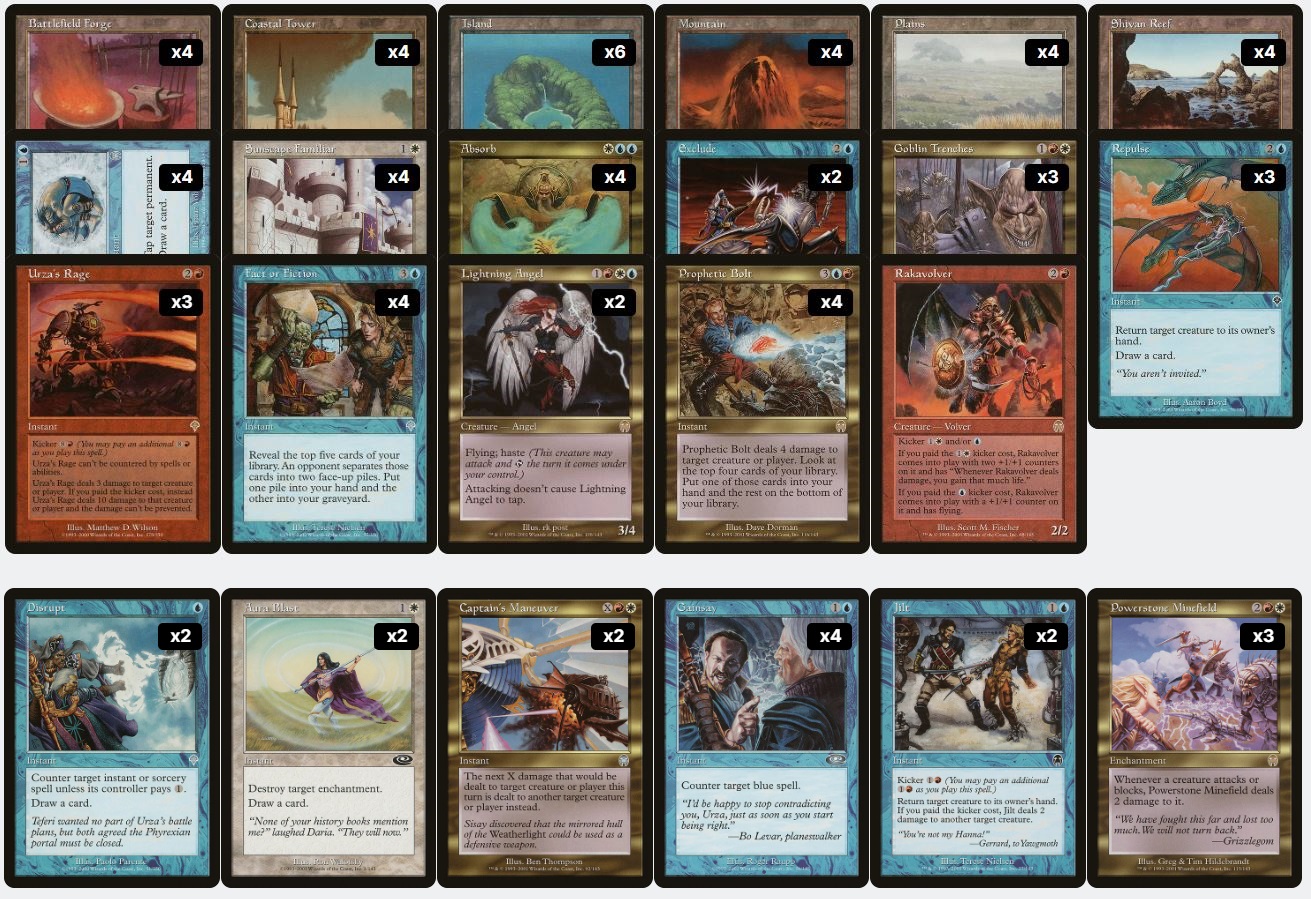
I sense this deck will perform much better if it untaps with Sunscape Familiar. Fact or Fiction and Prophetic Bolt team up for the first time among all of these decks, so I expect this deck will feel great to play when it survives the early-to-mid game. Powerstone Minefield is a disgusting card against the decks trying to attack for 2, but it negates Goblin Trenches as a win condition (unless Aura Blast is also boarded in).
Versus Domain
+2 Disrupt, +2 Aura Blast, +4 Gainsay
-1 Rakavolver, -2 Repulse, -2 Sunscape Familiar, -2 Fire // Ice, -1 Urza’s Rage
I assume that Pernicious Deed and Spiritmonger will look to answer this deck’s copious amounts of removal and Goblin Trenches; the sideboard strategy is to limit the strength of Deed and outdraw the Domain player. Aura Blast may be necessary to remove Destructive Flow, but it may also force Domain to have 8 mana to play Deed and activate it with countermagic for protection.
Versus BRW
+2 Disrupt, +2 Captain’s Maneuver, +2 Jilt
-2 Urza’s Rage, -1 Repulse, -1 Prophetic Bolt, -1 Goblin Trenches, -1 Sunscape Familiar
I believe this matchup will play out wildly differently based on the draws of the two decks, and I want to test both Jilt and Captain’s Maneuver against aggressive decks threatening kicked Urza’s Rage. The sideboard strategy is to reduce quantity on cards that have specific use cases so that too many of the same aren’t drawn in groups; I expect to change the amounts based on playtesting and probably if I am going first or second.
Versus UGR
+3 Powerstone Minefield, +4 Gainsay
-3 Goblin Trenches, -1 Repulse, -1 Absorb, -1 Prophetic Bolt, -1 Fact or Fiction
As the Tempo deck will look to bring in answers to Minefield, Gainsays and go up to 4 Disrupts, the goal of this sideboard swaps is to go leaner while supporting Powerstone Minefield. I expect to adjust this approach after getting some more experience on the play and draw.
Deck 3: Black-Red-White Midrange
Cassius Weathersby – Grand Prix Minneapolis 2001
Red-Black “Machine Head” Midrange was a staple throughout much of IBC, but I recall not enjoying the deck (despite finding some of the cards really appealing). At the end of the block format, I was experimenting with a Black-White deck to the point where the memory sticks out as one to be recalled over 20 years later; this three-color deck has a lot of the same approach as the Black-White deck (and I am eager to work on it to discover more possibilities in a format I long thought stagnant)!

Discard wears opponents’ resources down while the deck removes any problem permanents and puts pressure on their life total. This deck can sideboard into a huge amount of removal spells; don’t remove too many threats to ensure the deck will still be primed to win game 2 and 3! I am surprised there isn’t a single Phyrexian Arena in the 75 and that the deck only has 3 Battlefield Forge; I expect this deck will require a long time to slowly tune to my preference against the other decks!
Versus Domain
+3 Addle, +2 Aura Blast, +1 Emblazoned Golem
-1 Flametongue Kavu, -3 Shivan Zombie, -2 Goblin Trenches
Both Deed and Collective Restraint counter Goblin Trenches. Assuming Bobcats come in, 2-toughness attackers are worse (and I will try Emblazoned Golem to go over the top). Spiritmonger is potentially coming in, so some number of Terminate can remain (else the Shivan Zombies and/or the 4th Addle can be in). I am unsure how to play Addle, as both Green and Blue cards are in a high-enough density (but the Domain opponent will not be holding many spells into the late game); I will see if the full 4 are warranted after several matches.
Versus UWR
+4 Addle, +2 Aura Blast, +1 Flametongue Kavu, +1 Goblin Trenches
-2 Terminate, -3 Urza’s Rage, -1 Emblazoned Golem, -2 Spectral Lynx
Poorly aligned removal spells are removed for discard to wear down countermagic (or snag important card advantage). I think that Flametongue Kavu is okay in small doses to answer the Control deck’s small contingent of creatures (as opposed to other removal spells), and that the matchup will focus on whichever player can accrue the most value over time.
Versus UGR
+2 Flametongue Kavu, +2 Slay, +1 Terminate, +1 Emblazoned Golem
-1 Vindicate, -4 Shivan Zombie, -1 Goblin Trenches
Low-impact Shivan Zombie and Trenches are shaved for a huge influx of specialized removal. I am also thinking that Vindicate is worse than some of the alternative removal in the sideboard. It may warrant removing discard spells with UGR having access to Dodecapod… but let’s play some matches to recall if there is a great impact from the anti-discard creature.
Deck 4: Blue-Green-Red Tempo
Sigurd Eskeland – Grand Prix Oslo 2001
Where Red-Green Aggro was the aggressive villain during the Pro Tour missing Apocalypse prior to the IBC PTQ season, Green-Blue-Red Tempo seemed to dethrone the two-color variant as the qualifying season progressed. I do not recall Disrupt and remember seeing many Fact or Fictions, but Sigurd’s version of the deck seems very potent (despite having a meager 8 red sources to power some of its strongest cards).
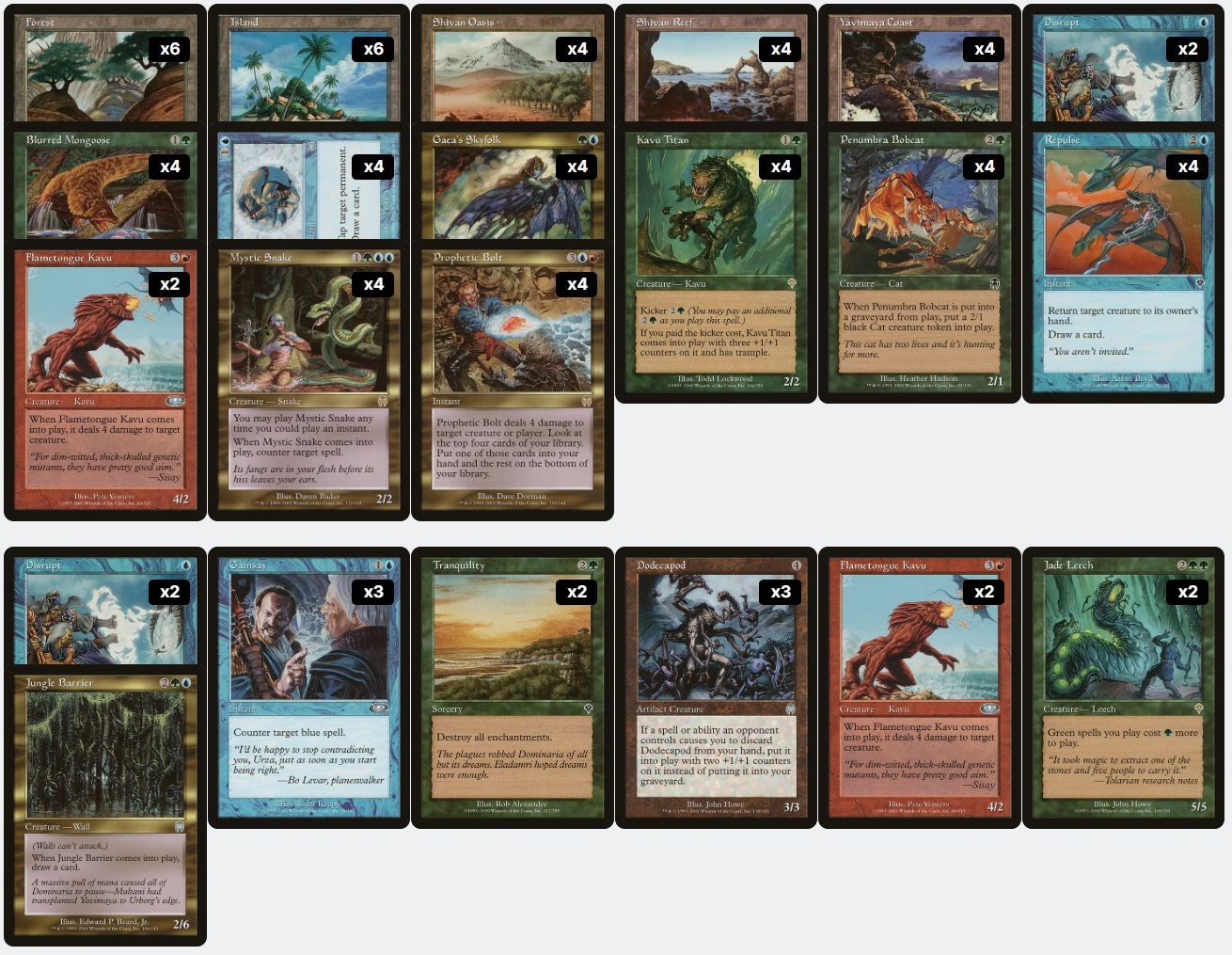
I recall Blue-Green-Red Tempo being a litmus test for decks to see if they had a chance to win at one point during IBC. Decks will quickly find their life reduced to zero by a flurry of burn if they are unable to stabilize above 8 life (and may still lose from there)! Though I don’t recall playing with Disrupt, the card seems particularly nasty during the first 5 or so turns (and must be respected during all phases of the game as a rare 1-mana interaction).
Versus Domain
+2 Disrupt, +2 Tranquility, +3 Gainsay
-2 Flametongue Kavu, -4 Repulse, – 1 Fire // Ice
It seems like an easy decision to bring in more countermagic and enchantment destruction against Domain, but there is a chance that some number of Repulse are useful against Spiritmongers. Blurred Mongoose and/or Penumbra Bobcat may also may up poorly against Bobcats from the 5-Color Control Deck.
Versus BRW
+2 Flametongue Kavu, +1 Jungle Barrier, +3 Dodecapod, +2 Disrupt, +2 Jade Leech
-3 Blurred Mongoose, -3 Repulse, -4 Mystic Snake
I assume that this matchup requires coming out on top with 2-for-1s and that bringing in so many 4-mana cards necessitates dropping all or most of the Mystic Snakes. There is a bit of a cat-and-mouse decision around bringing in Dodecapods; the card does not look great if the opponent removes most of their discard spells.
Versus UWR
+2 Disrupt, +2 Tranquility, +3 Gainsay
-2 Fire // Ice, -4 Repulse, -1 Mystic Snake
I assume that the efficient creature interaction is not very valuable, and the deck needs to focus on preventing Goblin Trenches resolving with a lot of resources. Both decks having access to Gainsay and Disrupt will make it dangerous to tap-out for high mana-value spells. It may be best to keep all Fire // Ice and cut more 4-to-5-mana cards.
What’s Next? Playing Games and Taking Names (of Cards to Change)
I plan to focus on playing these four decks against one another to (1) see if any are completely disadvantaged in a match up as well as to (2) attempt to identify underperforming cards. With any knowledge gleaned, I hope to make updates to make the gameplay as interactive as possible while also trying to improve the consistency of play patterns where possible. As games are played, I will share my notes on any changes (potential or concrete)- have a fun time slinging spells!
 Retro Trading Card Games