
Please find the Prop 15/3 Metagame page from June 2025 below; I will catalog prior versions of this page as significant updates are made! The current version of the page may be found here. Apologies for any dead or missing links.
The nature of many retro Pokemon formats (lower numbers of interested players, low stakes to win, many competing retro formats from which to play) leads to little data being available on deck performance and the contents of lists. I will endeavor to update this page as new events occur but much of the contents are pure conjecture based on testing sessions. I am just a moderately skilled Trainer, have not delved into the probability behind deck construction/playing the Pokemon Trading Card Game and am fairly slow to come across new ways to build decks. Please accept these biases and share any insight you may have on how Prop 15/3 (Base-Gym) may be played competitively!
“Recent” Event 1 (2024.08.11): Brew City Old-School Showdown featured almost 20 players battling 15/3, but it is my understanding that very few competitors worked on new decks (or tested if they brought a deck not on Jason’s blog). It is my opinion that the event should not bolster the current iteration of Fire Blaine’s Rapidash / Wigglytuff / Muk as the top deck of the format, as it should lose to more combat-focused Lightning Wigglytuff / Dodrio decks or more consistency-focused decks that leverage Big Basics.
“Recent” Event 2 (2024.10.06): The TCGOne Prop 15/3 Mega Battle happened shortly after Brew City OSS and reaffirmed Lightning Dodrio decks as a top competitor but also introduced Psychic Slowpoke / Brock’s Mankey / Muk Lock as a metagame-defining deck (as well as a few other lists).
Decks must both be able to disrupt lock decks (Psychic Slowpoke / Brock’s Mankey / Slowpoke Lock) and withstand aggressive decks with the best attackers (Lightning-Fighting Dodrio Wigglytuff) in the game to be competitive. The tricky part is many lock/stall decks play high-damage-dealing Pokemon and aggressive decks may play Pokemon or Trainers to stall out the game while they setup to win. Counterplay to commonly played strong cards will go a long way toward winning games, and access to a single card in a matchup may be the difference between winning and losing (see my introduction to deck-building in 15/3 for more information on commonly played cards and their potential counters)!
The End of Year 2024 Metagame Summary can be viewed here!
The Metagame Summarized – February 2025
The “deck to beat”, Dodrio decks with Big Basics (and sometimes additional Evolution lines) dominate due to their ability to play multiple Gust of Wind and Super Energy Removal (as well as other disruptive Trainers and hefty dose of Item Finders). Though, some versions may play Pokemon Traders instead of the third copy of Professor Oak and/or Computer Search. The Big Basic strategy is its own form of consistency: each Pokemon drawn operates effectively with just an energy or two.
Lightning deck’s Rocket’s Zapdos and Electabuzz are a tyrannical pairing (making Clefable one of the better Evolutions with its ability to one-attack KO the Rocket’s Zapdos and hit other bruisers for a single energy). These decks look to win games through high efficient gameplay with hard-hitting attacks supplemented by smaller bits of disruption. It appears these decks gain an advantage by playing at least two Types of Pokemon, one often Fighting, to attack more often for weakness; Fighting-Psychic, Fire-Fighting and Lightning-Fighting all appear to be competitive pairings.
In theory, these Dodrio Big Basic decks may be rivaled by opponents with hard-hitting Evolutions (and the Pokemon Powers they wield) along with type resistance and toolbox approaches. Base Set Electrode, Dragonite, Blastoise, Brock’s Ninetales and Venusaur are some Pokemon that could support an effective game plan against Big Basics and disruptive Trainers. Koga’s Pidgey, Dark Dragonair and Dark Dragonite open up playing specific Pokemon with niche application without playing too many consistency trainers. Primarily, these decks look to survive the early game and then overpower their opponents usually while leveraging one or more Pokemon Powers and game-warping Trainers.
The Evolution-based and/or toolbox decks (and Dodrio decks that introduce Evolutions or types of Energy) have to contend with the lock and stall strategies: high amounts of Energy Removal, Slowpoke, Brock’s Mankey, Muk, Aerodactyl and Dark Vileplume. Muk may also be included in decks that take more of a Big Basic or Evolution approach (at the cost of making those decks slightly worse against other Big Basic decks). Alternatively, a stall deck may look to play Dodrio and perfectly lineup attackers against popular strategies to win on prizes. Lock and stall decks require careful management of resources to beat (and having some cards dedicated to the match-up will help immensely).
It’s important to consider that decks operate on a spectrum of strategies, varying their approach as they draw cards and anticipate or respond to their opponents’ actions. Be flexible and be successful: the Prop 15/3 (Base-Gym) metagame is still evolving and there is a lot of room for exploration. I hope to share my journey testing decks and ideas in further posts and updates to this blog. Enjoy brewing and battling!
Criteria Used
Decks are put into Tiers by the following criteria:
- Power Level
- Strong – These decks can both attack for large amounts of damage and have access to disruptive effects that lead to game-winning positions. These are the decks that are frustrating to play against without an understanding of how to beat them.
- Moderate – These decks either attack for large amounts of damage and have access to disruptive effects that lead to game-winning positions. Decks will need to hit or have promise to hit this threshold to make it on the Tier List.
- Weak – These decks don’t attack for large amounts of damage of have access to disruptive effects that lead to game-winning positions. These decks might be candidates for a competitive deck with additional modification but otherwise will not make the below Tier List.
- Resiliency
- Resilient – These decks do not overly rely on any one card or set of cards to play (and win) the game. Do not mistake decks that are frequently able to win the game after giving up 3-5 prizes as fragile.
- Fragile – These decks rely on a particular one card or set of cards to compete and eventually win. Decks that have a substantial or multiple “single points of failure”.
- Consistency (Deck Construction)
- Very Consistent – These decks are categorized by large amounts of consistency (glue) Trainers (or Pokemon that emulate glue) or many redundant cards (from a strategic standpoint). Often, these decks are Big Basic decks.
- Somewhat Consistent – Decks that cut glue Trainers and Pokemon for more disruptive cards will fall into this category. These decks will often feel like they desperately need the play Professor Oak (but still can win some games never playing the Trainer). They may also run out of cards before winning from a commanding position in a smaller amount of their games.
- Inconsistent – These decks may have trouble assembling their winning strategies against minimal disruption or may not easily win the game before running out of cards (and losing).
- Consistency (Card Effects a.k.a. Coin Flips)
- Very Consistent – These decks do not rely on winning coin flips to win a game (and won’t lose many games on the outcome of a single flip). (Though, a couple “heads” flips never hurt any Pokemon Trainer…)
- Somewhat Consistent – These decks usually do not rely on winning coin flips to win a game (though they may need to hit the average outcome of their flips). However, they may lose a game to a bad flip.
- Inconsistent – These decks are categorized through their need to win several flips or a very important flip to win games. Often, these decks will not make the Tier List or be Tier 3.
- “Single Points of Failure” – These are specific Weaknesses (either Type Weakness/Resistance or weakness to a specific card) that are hard for a deck to overcome.
So with the above in mind, with the understanding that a few cards changed can move decks across tiers, my view of the early 2025 metagame was is follows:
Tier 1 – Top Decks
These decks win a lot and do not lose noticeably more against other particular Tier 1 or Tier 2 decks.
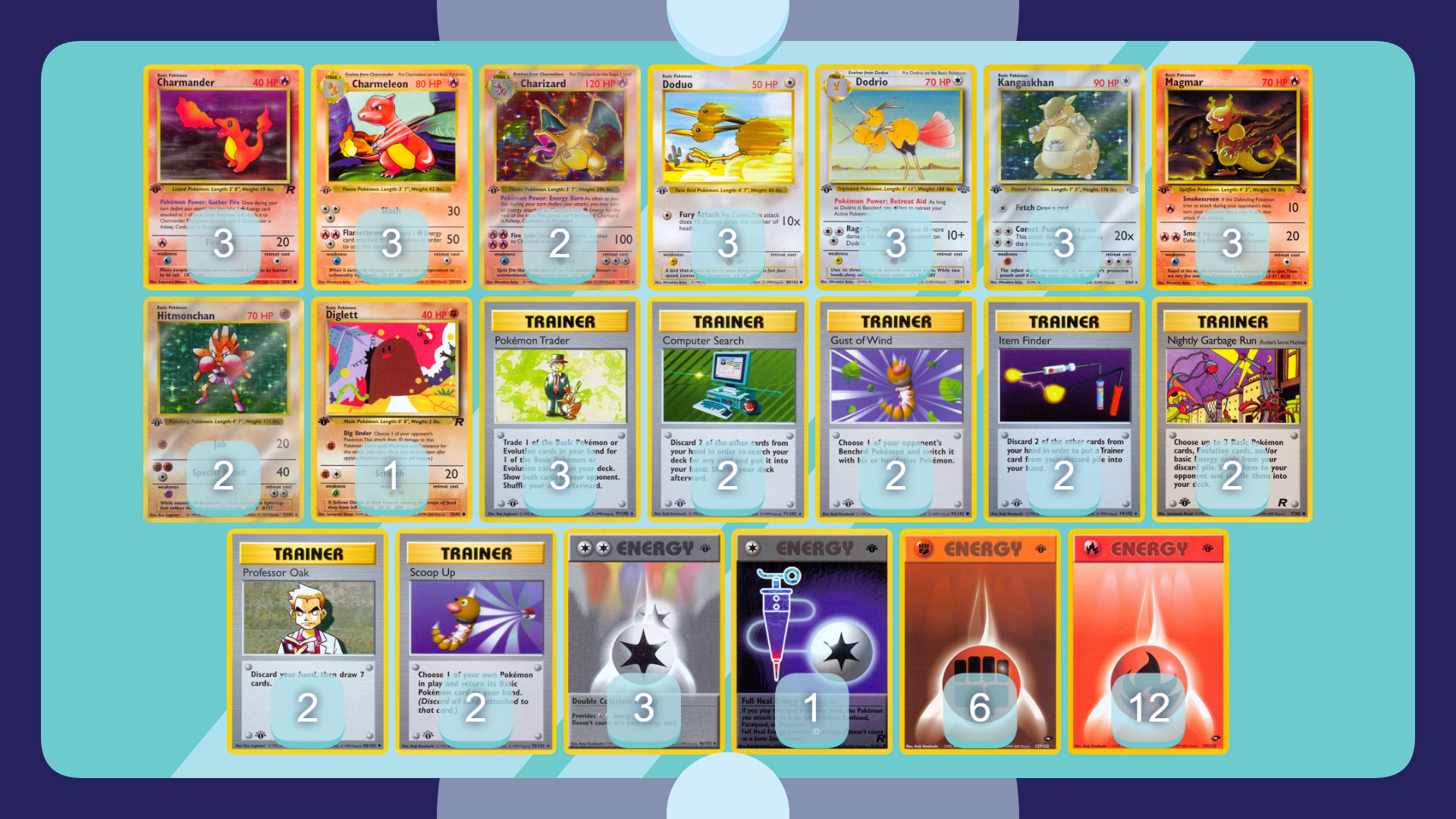
Fire-Fighting Charizard / Dodrio
LIST UPDATED ~2025.01.07
- Power Level – Strong – Charizard’s entire Evolution line have powerful attack options, and the Fighting Pokemon offer lots of damage potential for a single Energy against some of the best Pokemon in the format.
- Resiliency – Resilient – Gather Fire, Scoop Ups, Resistance and Big Basics give the deck many options to attack
- Consistency (Deck Construction) – Almost Very Consistent – Three Kangaskhan and three Pokemon Traders form the core of the deck; don’t be surprised if the deck wins without ever playing a Professor Oak! Also, the deck can function on its other Big Basics when dictated by the starting draw.
- Consistency (Card Effects) – Very Consistent – Few cards rely on coin flips for strength. The deck may even consider dropping the third Fossil Magmar for another Fighting or Colorless-attacking Pokemon.
- Single Points of Failure – Water Weakness – Multiple Water attackers can make quick work of this deck’s namesake Fire Evolutions, but I haven’t found a particularly convincing Water deck to worry about yet.
After further testing, Charizard (well, primarily Charmander and Charmeleon) with Dodrio, a slower approach to using Professor Oak, Big Basics and Scoop Ups can convincingly compete against Lightning Dodrio decks (including varieties with Fighting or Evolutions, though Hitmonchan can do some serious damage). The deck’s lineup of lean attackers (Hitmonchan, Magmar, Charmander and Dodrio) with the Gather Fire into Charmeleon possibilities also make it competitive against Slowpoke Lock.
See the Charizard Deck Diary page for ideas on how the Fire Lizard plays in 15/3.
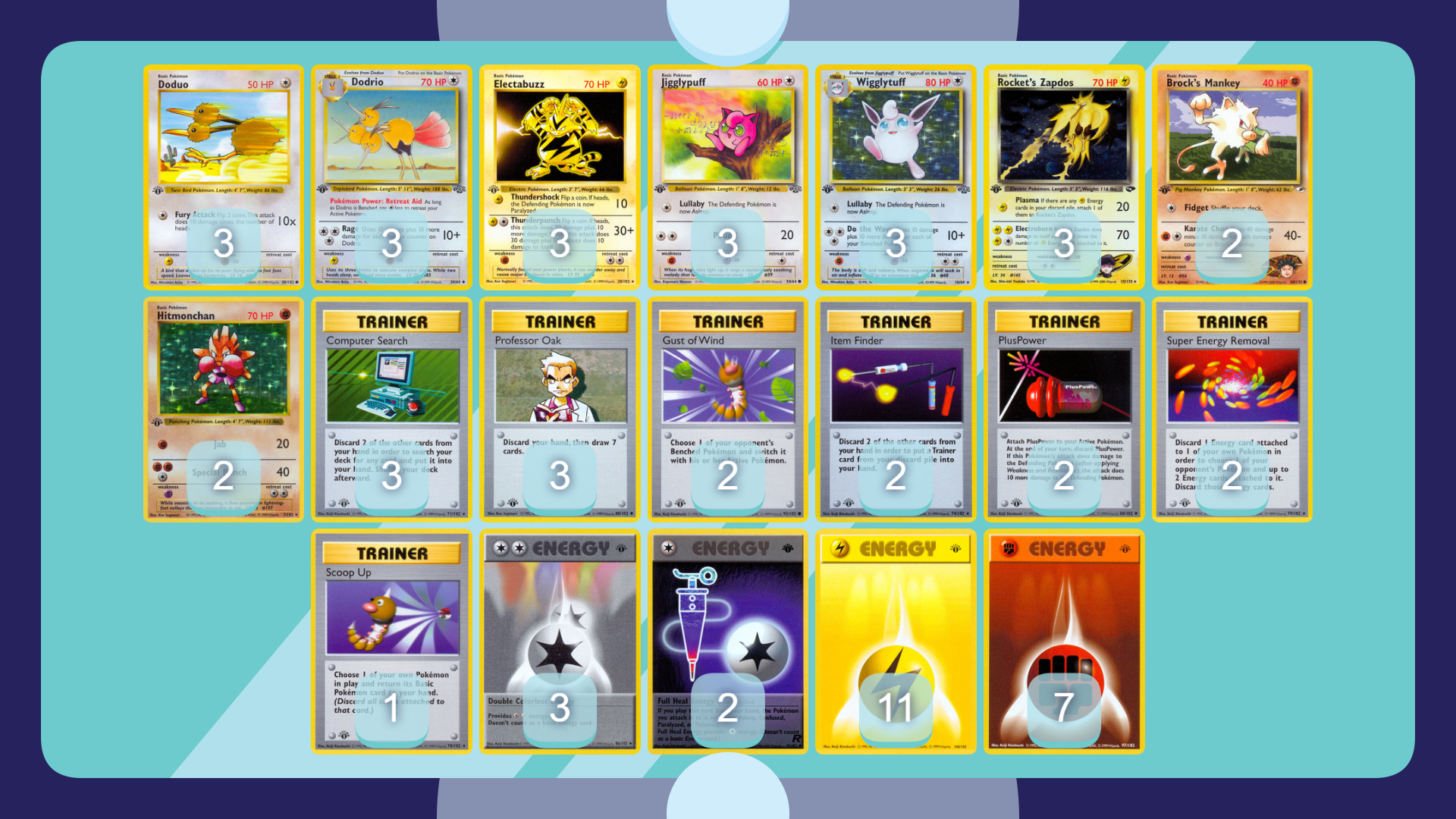
Lightning-Fighting Wigglytuff / Dodrio
LIST UPDATED 2025.02.01
- Power Level – Strong – Rocket’s Zapdos, Electabuzz and Wigglytuff are three of the most efficient damage-dealers in the format, and the Fighting Pokemon offer lots of damage potential for a single Energy against some of the best Pokemon in the format.
- Resiliency – Resilient – The deck’s ~8 Big Basics play a similar game while Evolutions can be built as they are drawn. A large variety of disruptive Trainers allow for neutralizing opposing threats from many different situations.
- Consistency (Deck Construction) – Consistent – The Big Basics game plan supplemented by glue Trainers plays out with similar patterns over many games.
- Consistency (Card Effects) – Very Consistent – Few cards rely on coin flips for strength.
- Single Points of Failure – Resistance without Dodrios – Without the ability to cheaply retreat, this deck’s Pokemon can get matched up against attackers that resist the majority of damage dealt.
The Lightning Wigglytuff / Dodrio deck but with Hitmonchans. This was my pick for best deck prior to the TCGOne Mega Battle; I feel it has an edge against Lightning variants and while it may suffer some against Lock decks, careful play can mitigate the weakness. As there are a lot of possible Trainer/Pokemon configurations to consider, I hope to do a deep dive on multiple approaches to the strategy, but I’d like to highlight among the most aggressive version (playing PlusPowers and no Kangaskhan).
For more insight on this list (both playing or playing against it) as well as possible cards to play, see the Deck List Details page [not yet created]. See the Big Basics Deck Strategy Spotlight page for ideas on similar decks.
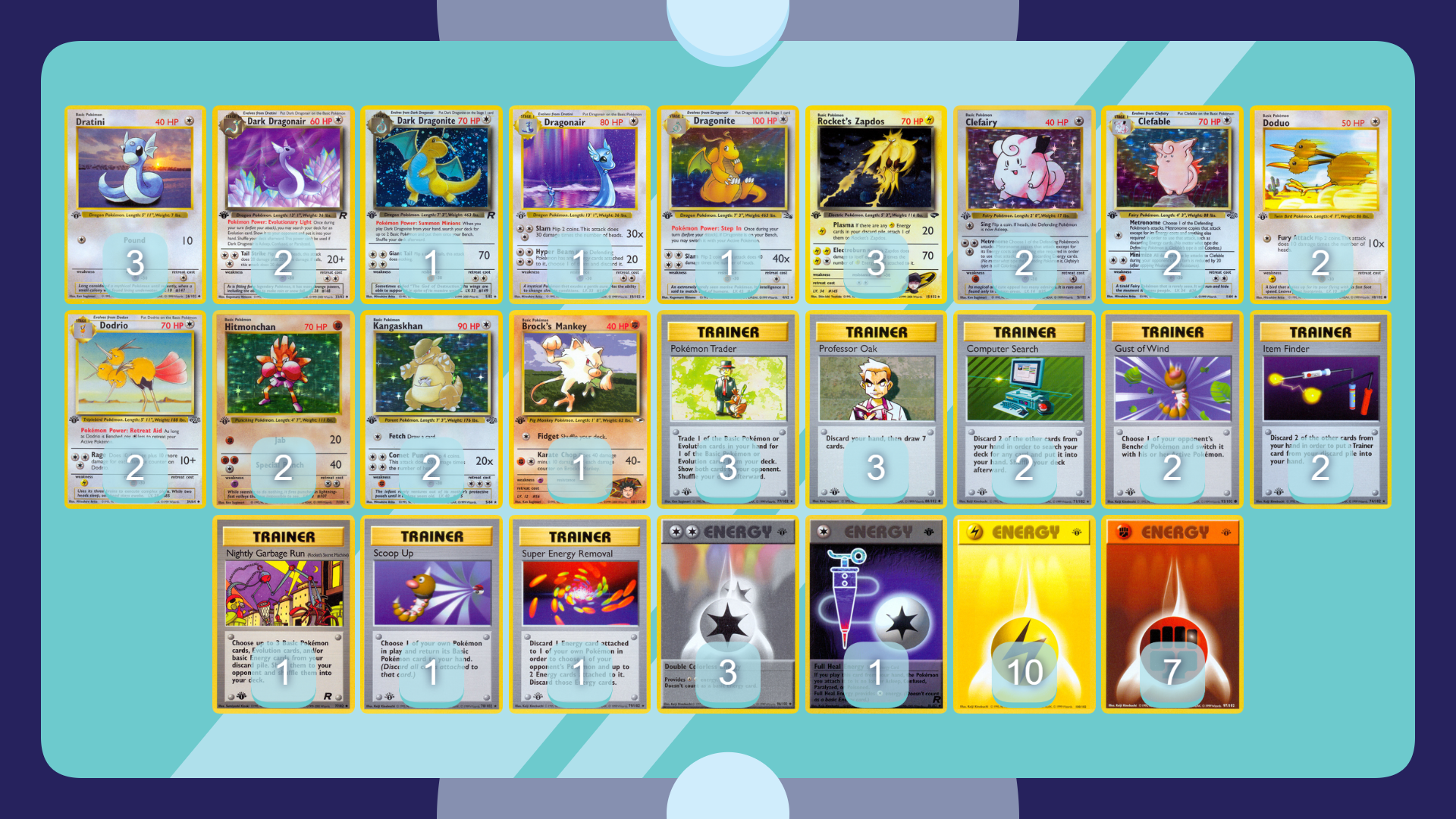
Lightning-Fighting Dark Dragonite / Clefable / Dodrio Box
LIST UPDATED 2025.02.02
- Power Level – Strong – Rocket’s Zapdos, Clefable, Hitmonchan and Brock’s Mankey can do massive amounts of damage with only one or two Energy cards from hand. Dodrio and Dragonite give the deck extra flexibility to switch between attackers.
- Resiliency – Resilient
- Consistency (Deck Construction) – Very Consistent – The Big Basics game plan supplemented by glue Trainers plays out with similar patterns over many games; additions of Khangaskhan and Dark Dragons give the deck a tons of speed to assemble specific Pokemon.
- Consistency (Card Effects) – Very Consistent – Few cards rely on coin flips for strength.
- Single Points of Failure – Weak Starting Pokemon – Hands with only a Clefairy or Dratini as a Basic Pokemon will put the deck at a disadvantage.
This was my pick for countering Lightning-Fighting Dodrio Wigglytuff prior to the TCGOne Mega Battle (as it can setup perfect attackers much more quickly and isn’t very vulnerable to Super Energy Removal); I feel it has an edge against Lightning variants but may suffer some against Lock decks. It will need some additional testing to determine the correct configuration of cards in the toolbox!
See the Big Basics Deck Strategy Spotlight page for ideas on similar decks.
Tier 2 – Contender Decks
These decks seem to lose against Tier 1 decks more than they win. Often, they have a linear approach or sacrifice some consistency or power. I assume many of these decks have options to change a few cards to win more games or may perform better in different metagames.
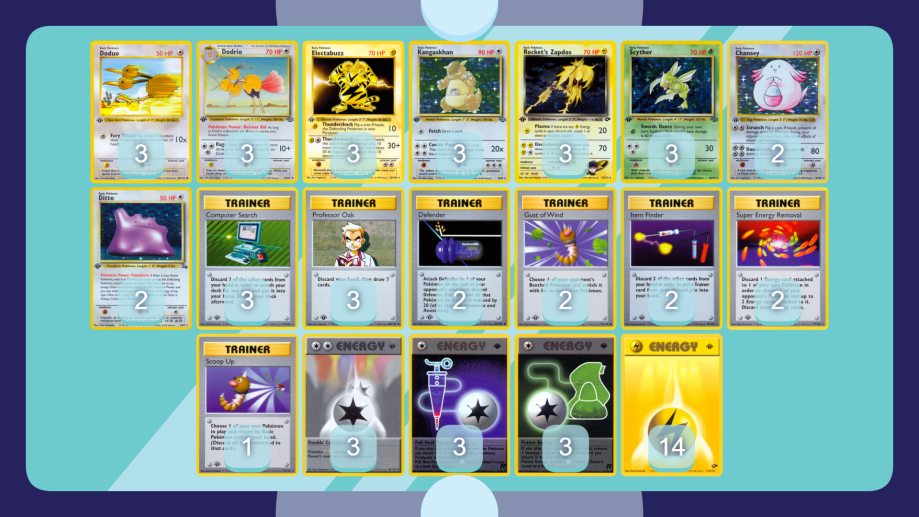
Lightning Dodrio
LIST UPDATED 2024.10.10
- Power Level – Moderate – Rocket’s Zapdos and Electabuzz are two of the most efficient damage-dealers in the format, but the deck is missing an easy-to-power-up-big-damage attacker like Wigglytuff or another Type to attack for Weakness.
- Resiliency – Somewhat Resilient – The deck can have difficulty against decks that easily KO Electabuzz and Rocket’s Zapdos.
- Consistency (Deck Construction) – Very Consistent
- Consistency (Card Effects) – Very Consistent
- Single Points of Failure – Clefable and Fighting-Type Pokemon can be very difficult to overcome.
Almost the same list that won the TCGOne Prop 15/3 Mega Battle, this deck looks to attack effectively with Rocket’s Zapdos and Electabuzz or build resources with Kangaskhan while assembling attackers on the bench. Repeated Gust of Wind, Defender and Super Energy Removal give the deck many options to come out favorable when trading attacks. A single Scoop Up is to prevent Kangaskhan from getting stuck in the active (and provide some additional ability to prevent the opponent taking a prize). The deck may consider switching some of the basics and playing Grass and/or Potion Energy over some number of Lightning Energy. I assume that Scyther is counterplay against Brock’s Sandslash.
[LINK forthcoming]For more insight on this list (both playing or playing against it) as well as possible cards to play, see the Deck List Details page. See the Big Basics Deck Strategy Spotlight page for ideas on similar decks.
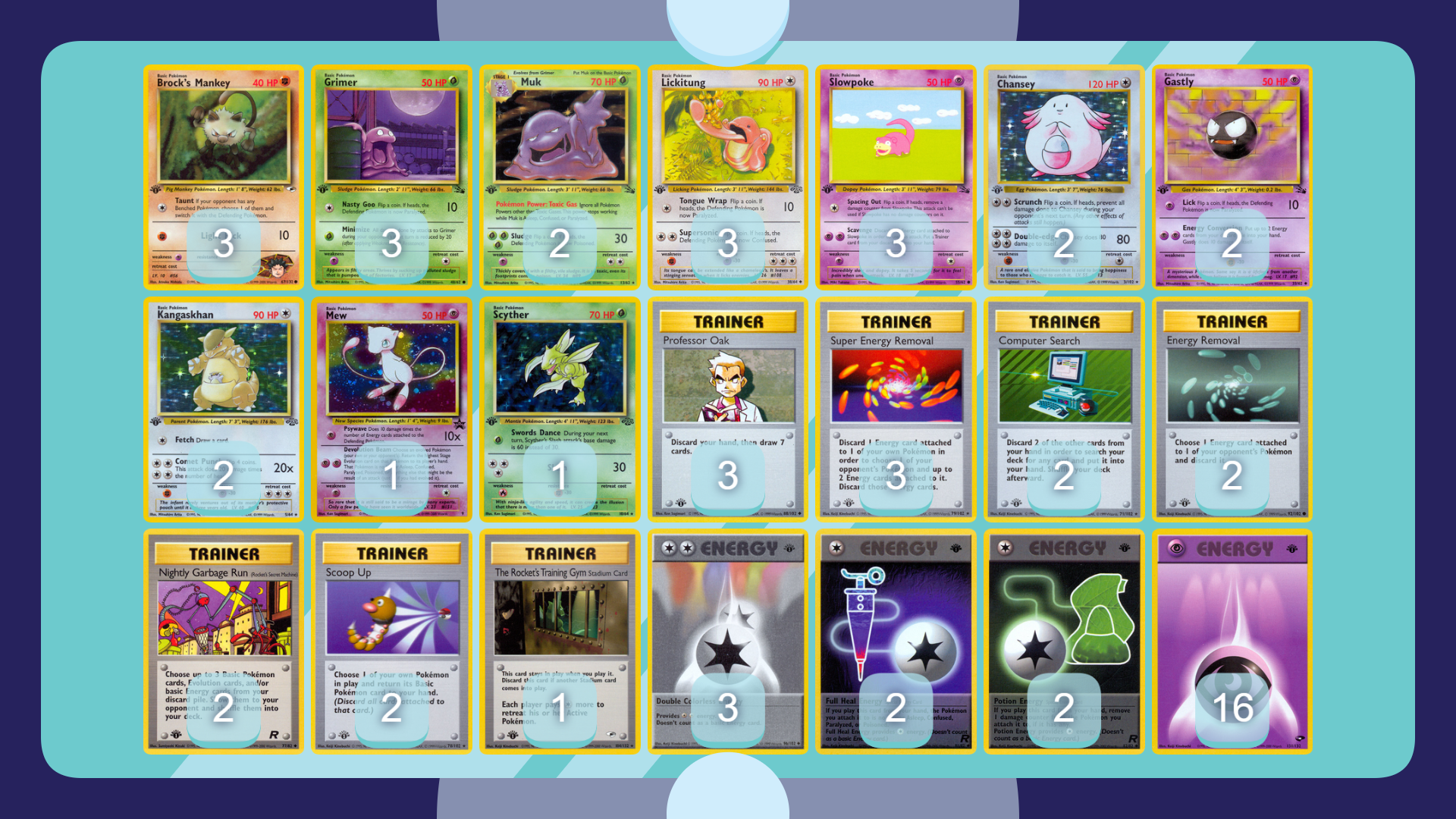
Psychic Slowpoke / Brock’s Mankey / Muk Lock
LIST UPDATED ~2025.01.18
- Power Level – Strong – On the back of disruptive Trainers and Pokemon, this deck can create a strangling hold the opponent may never resist.
- Resiliency – Resilient – Professor Oaks, Computer Searches, Nightly Garbage Runs and 5 Energy Removal cards ensure this Lock deck can enact its plan to outlast the opponent’s resources. The deck can suffer from weak Basic starting Pokemon.
- Consistency (Deck Construction) – Consistent – Lower on glue Trainers and Mon, the deck may use paralysis attacks to prolong the game and draw needed cards.
- Consistency (Card Effects) – Very Consistent – With approximately 50 percent heads, this deck has a chance to paralyze many turns.
- Single Points of Failure – Rocket’s Zapdos and free retreaters are enough to win some games. Scoop Up can counteract attempts to strand an active. Imposter Oak’s Revenge can counter a Slowpoke in the later game.
Jason’s deep understanding of the format led to creating this monster: a deck that doesn’t need to take a single prize (but is capable of taking 6) as the opponent runs out of first energy and then cards. Often, this is done by taunting a high-retreat, high-energy attacker into the active while Muk prevents Pokemon Powers from supporting the stranded Mon.
For more insight on this list (both playing or playing against it) as well as possible cards to play, see the Deck List Details page.
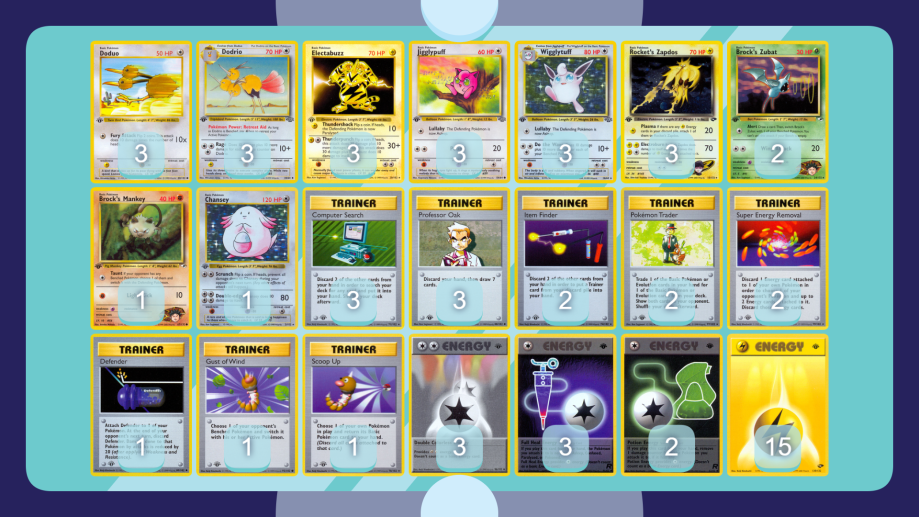
Lightning Wigglytuff / Dodrio
LIST UPDATED ~2024.08.28
- Power Level – Strong – Wigglytuff, Rocket’s Zapdos and Electabuzz (again).
- Resiliency – Somewhat Resilient – The deck can have difficulty against decks that easily KO Electabuzz and Rocket’s Zapdos.
- Consistency (Deck Construction) – Very Consistent
- Consistency (Card Effects) – Very Consistent
- Single Points of Failure – Clefable and Fighting-Type Pokemon can be very difficult to overcome.
Some of the best cards from the Super Trainer Showdown in 2000 are still among the best today. The Mana Vault’s Sam B. played this archetype to convincing records at both the Brew City OSS and the TCGOne Mega Battle. There are a lot of possible Trainer configurations to consider.
For more insight on this list (both playing or playing against it) as well as possible cards to play, see the Deck List Details page [not yet created]. See the Big Basics Deck Strategy Spotlight page for ideas on similar decks.
Grass Koga’s Beedrill / Muk Box
UNTESTED, UPDATED 2025.02.02
- Power Level – Moderate – The deck does not have means to take OHKOs.
- Resiliency – Somewhat Resilient – The deck can have difficulty against decks that easily KO Electabuzz and Rocket’s Zapdos.
- Consistency (Deck Construction) – Very Consistent – Kangaskhan and Brock’s Zubat supplement a high amount of glue Trainers.
- Consistency (Card Effects) – Somewhat Consistent – Koga’s Beedrill relies on flipping an average amount of heads.
- Single Points of Failure – No aggressive Big Basics make it harder to win with draws missing glue cards. Pokemon Center can also be a difficult card to play against.
This deck is to be tested further with Kangaskhan, though another version fared well against Lightning Dodrio variants. Koga’s Beedrill can take out many opposing Pokemon while taking little damage itself with some luck. Grimer, Brock’s Zubat and Kangaskhan give the deck some more options to have a good starting Pokemon. With Grimer, the deck has options to evolve into Dark Muk or Muk when they provide advantage.
For more insight on this list (both playing or playing against it) as well as possible cards to play, see the Deck List Details page.

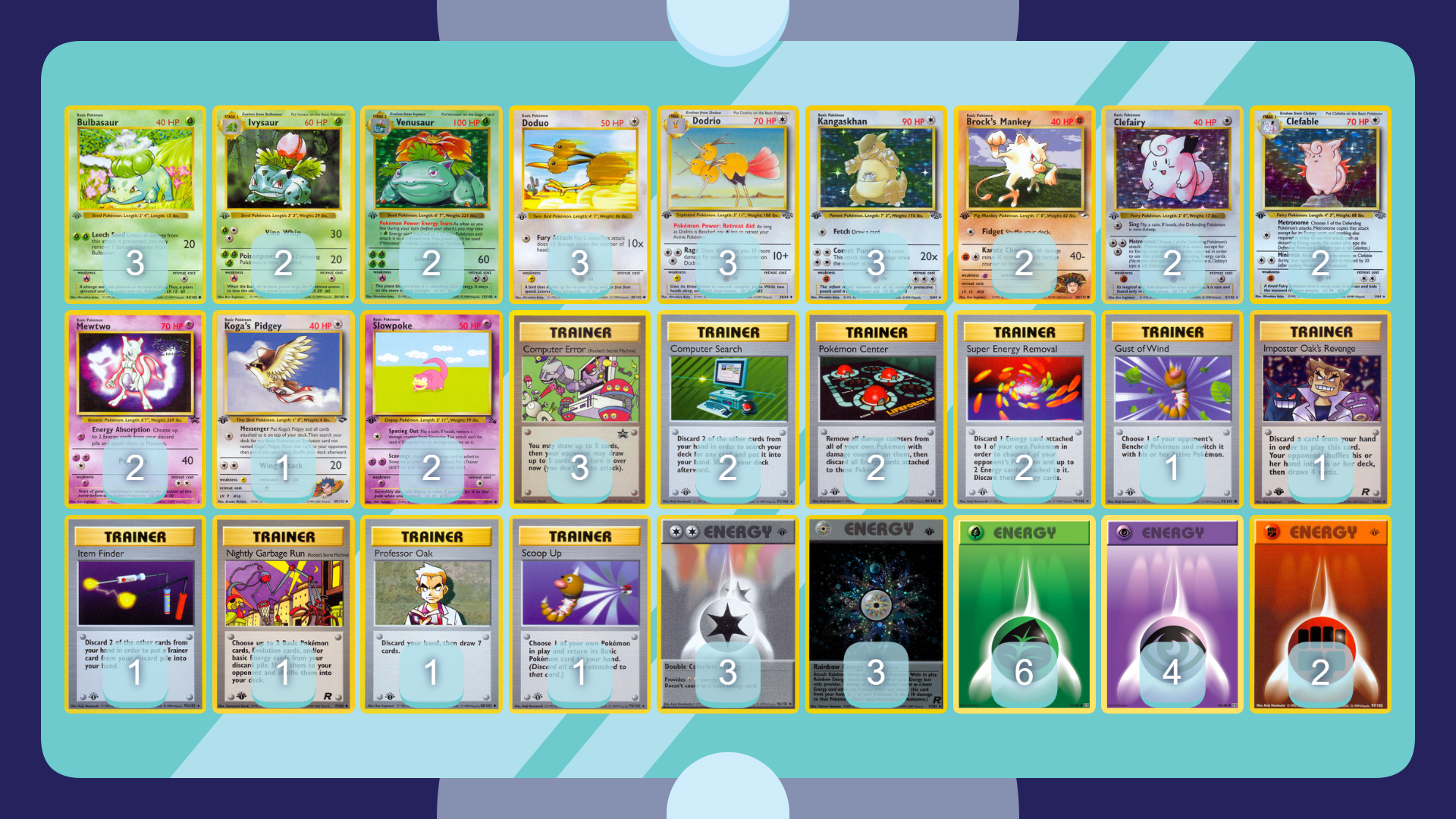
Grass-Psychic-Fighting Venusaur / Slowpoke (Computer Error) Stall
UPDATED 2025.01.26
- Power Level – Strong – Venusaur, low-cost retreating and Pokemon Center is a strong combination against any deck that is looking to take 6 prizes and cannot easily OHKO. Brock’s Mankey, Mewtwo and Clefable can OHKO commonly played Pokemon from opponents.
- Resiliency – Somewhat Resilient – The deck can have difficulty against decks that easily KO Bulbasaurs and Ivysaurs.
- Consistency (Deck Construction) – Somewhat Consistent – A lower number of glue Trainers can lead to long games before the Venusaur deck sets up the perfect bench.
- Consistency (Card Effects) – Very Consistent
- Single Points of Failure – Games can be difficult without Venusaur; while Muk can be difficult, losing Bulbasaurs and Ivysaurs to knock outs is worse.
Venusaur and Pokemon Center gives the deck very potent counterplay to Lightning-Fighting opponents when Venusaur survives the early game. Computer Error may lead to the opponent decking out before they expect (if Imposter Oak’s Revenge doesn’t set their hand to a small 4 cards); the deck has been able to win some games against Lightning-Fighting (but it is an uphill battle). The deck looks to slowly setup the perfect bench while threatening OHKOs; Professor Oak is available when a large influx of raw resources are needed to continue the game. Lastly, the deck can fall back on Slowpoke in the late game to recycle Trainers and create a position difficult for opponents to overcome.
For more insight on this list (both playing or playing against it) as well as possible cards to play, see the Deck List Details page [not yet created].
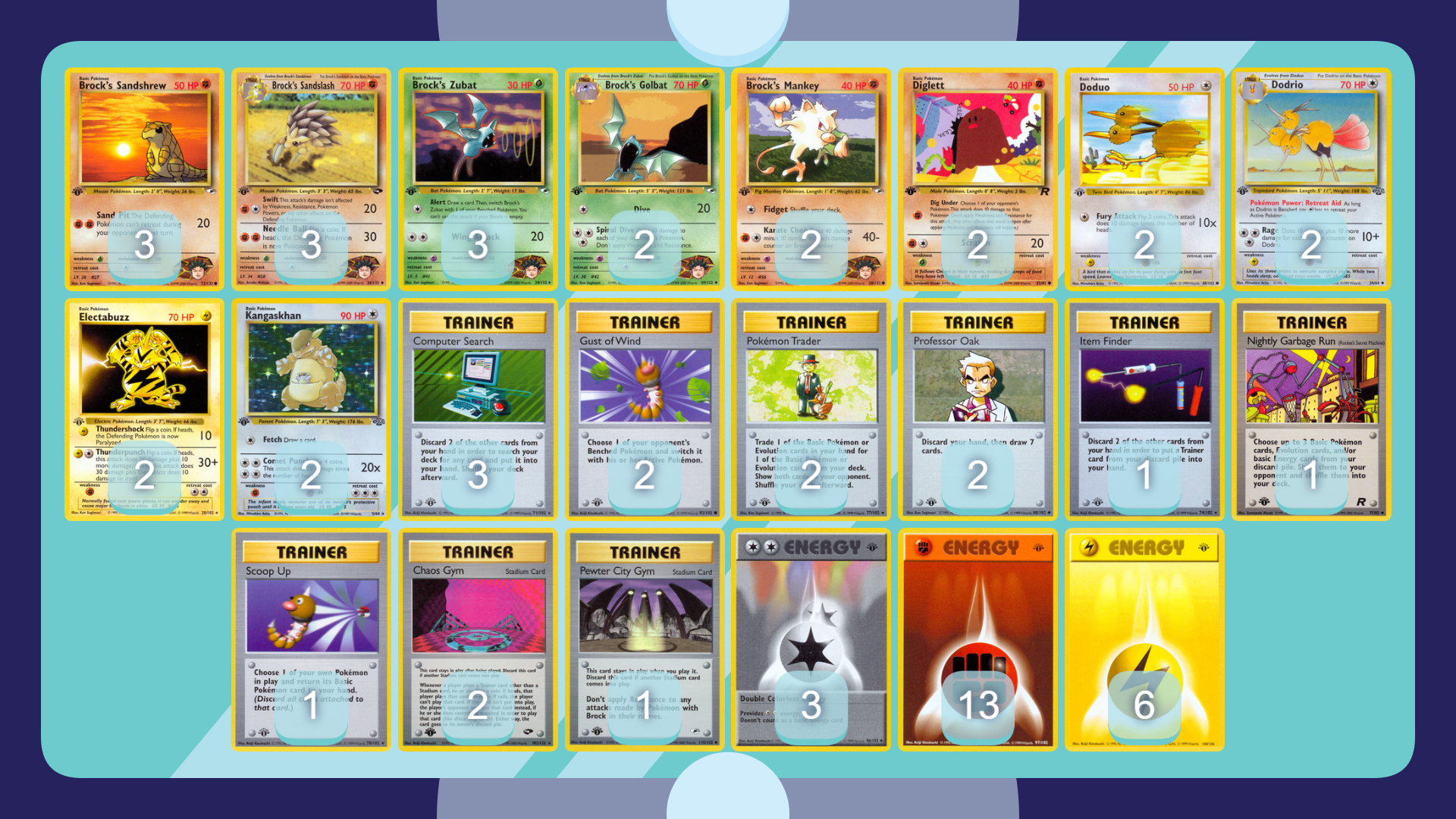
Fighting-Lightning Brock’s Sandslash
UPDATED 2025.02.07
- Power Level – Moderate – The deck doesn’t have any of the format’s conventionally-considered best attackers, though Electabuzz, Brock’s Mankey (68) and Brock’s Sandslash are about as good as attacking can get in Prop 15/3.
- Resiliency – Resilient – All three Resistances (Psychic, Lightning and Fighting) are in great quantity, and the deck plays many redundant Pokemon to draw cards and attack for damage.
- Consistency (Deck Construction) – Somewhat Consistent – A lower number of glue Trainers and Chaos Gym’s interference can lead to longer games with both players having less resources and agency.
- Consistency (Card Effects) – Inconsistent – Chaos Gym is a fickle card.
- Single Points of Failure – Relying on Chaos Gym is only ever a 50 percent chance (and getting it later in the game can negate much of its advantage).
Brock’s Fighting Pokemon rely on Pewter City Gym to surpass Resistances in most matchups, so the deck can have trouble when the Gym is not found early, but this version of the deck relies on Sandslash’s Swift attack, Brock’s Bats, Diglett and Electabuzz to attack Fighting-Resistant Mon. (It doesn’t even play Hitmonchan as to not be as weak to Fighting Resistance!) Brock’s Protection is replaced by the Prop 15/3 terror Chaos Gym; between Zubat and Kangaskhan, this deck looks to overpower other decks in a no-Trainer game state. Lastly, it can temporarily replace its own Chaos Gym with Pewter City Gym in the later game for a truly unfair-feeling (for the opponent) situation!
I assume that Lightning-based decks are playing Scyther out of fear of Brock’s Fighting Mouse Pokemon. This deck may be a good case study in how to use Chaos Gym in other Prop 15/3 (Base-Gym) decks. For more insight on this list (both playing or playing against it) as well as possible cards to play, see the Deck List Details page.
Tier 3 – Unproven Decks
These decks are untested or have initially tested poorly. I mention them as they seem like possible competitors (for which I’ve yet to find lists I’d concretely say “are competitive”).
Decks not below that may eventually find competitive lists include: Blastoise, ErikaBox (Erika’s Maids-based Toolbox), Dark Vileplume, Buzzap (Base Set Electrode), Dark Raichu, Potpourri (Weakness-exploiting Basics), Medicate (Lt. Surge’s Raticate & Mr. Mime), Alakazam, and many more
Water Misty’s Poliwhirl / Clefable / Muk Stall
UPDATED ~2024.12.20
Misty’s Poliwhirl can supplement Energy Removals while Muk turns off Pokemon Powers. Clefable threatens Rocket’s Zapdos. I would like to see how this deck develops with more testing.
For more insight on this list (both playing or playing against it) as well as possible cards to play, see the Deck List Details page [not yet created].

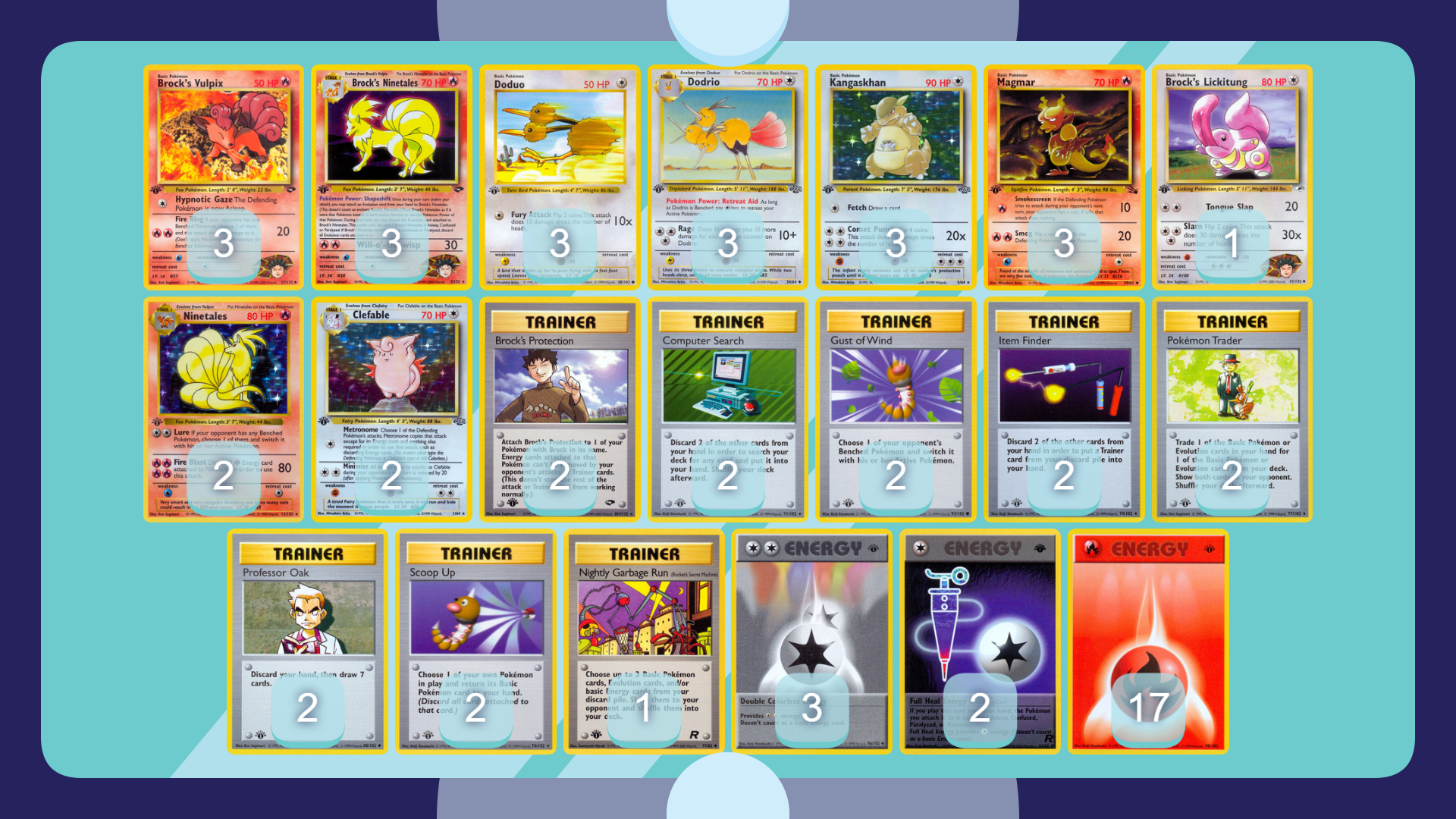
Fire Blaine’s Charmander / Brock’s Mankey / Muk Lock
UPDATED ~2024.10.22
Blaine’s Charmander and Blaine’s Vulpix combine to remove possibly every Energy card from the opponent. I haven’t seen this deck in action much so cannot comment on how viable it is.
For more insight on this list (both playing or playing against it) as well as possible cards to play, see the Deck List Details page [not yet created].

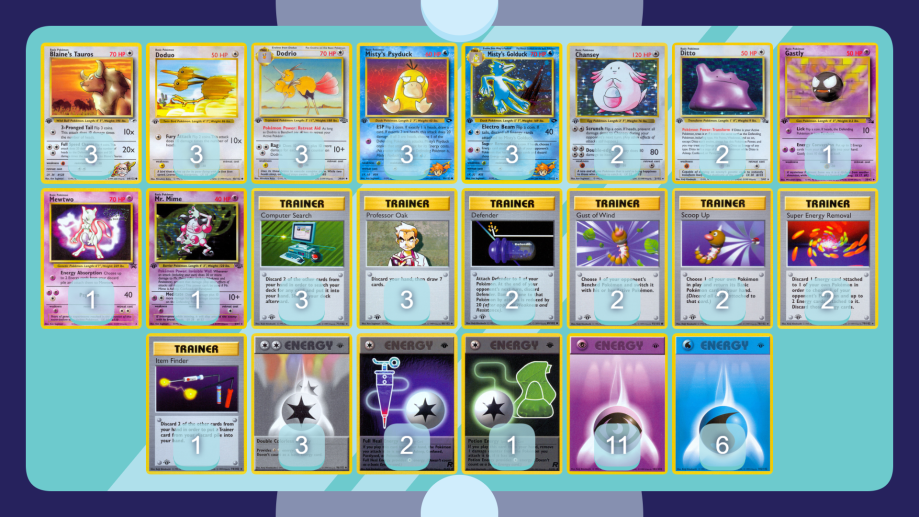
Psychic-Water Misty’s Golduck / Dodrio Stall
UPDATED ~2024.12.20
Originally designed as a counter to Fire Blaine’s Rapidash / Wigglytuff / Muk, this deck hits hard when the flips are in its favor: Super Removal success being a very strong attack. There are a lot of options for Energy, Trainers and Basics.
For more insight on this list (both playing or playing against it) as well as possible cards to play, see the Deck List Details page [not yet created]. See the Big Basics Deck Strategy Spotlight page for ideas on similar decks.
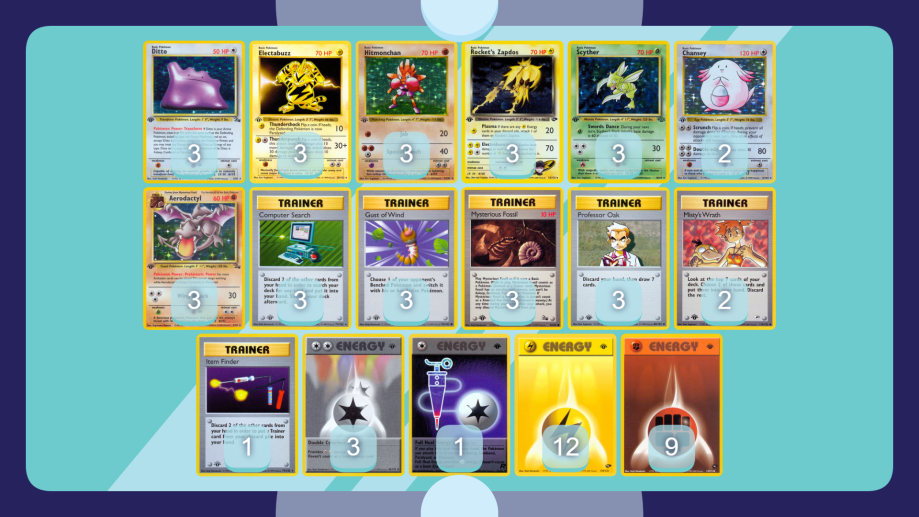
Lightning(-Fighting) Aerodactyl Lock
UPDATED ~2024.10.06
Aerodactyl seems to underperform against Dodrio decks, but it can be game-ending against decks relying on Evolutions and without many Gust effects. The deck can also look to play Erika’s Clefairy to evolve on turn 1.
For more insight on this list (both playing or playing against it) as well as possible cards to play, see the Deck List Details page [not yet created]. See the Big Basics Deck Strategy Spotlight page for ideas on similar decks.
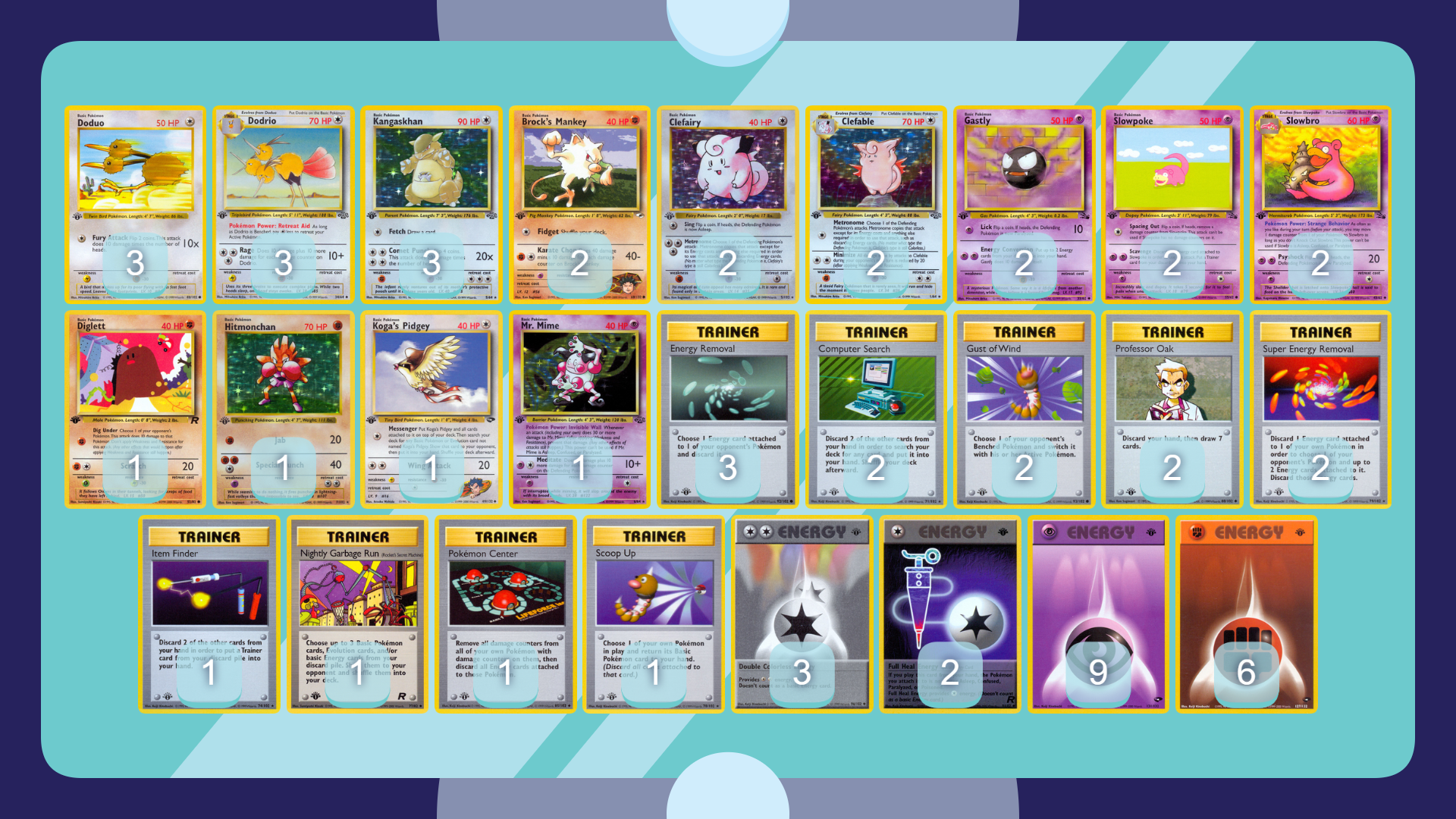
Fighting-Psychic Dodrio Slowbro Box Stall
UNTESTED, UPDATED 2025.01.26
In theory, this deck looks to combine a large amount of Energy removal with Gusts and OHKO to ensure the opponent cannot build strong attackers. Slowbro protects attackers and Slowpoke offers late-game strength when more Trainers are needed.
For more insight on this list (both playing or playing against it) as well as possible cards to play, see the Deck List Details page.
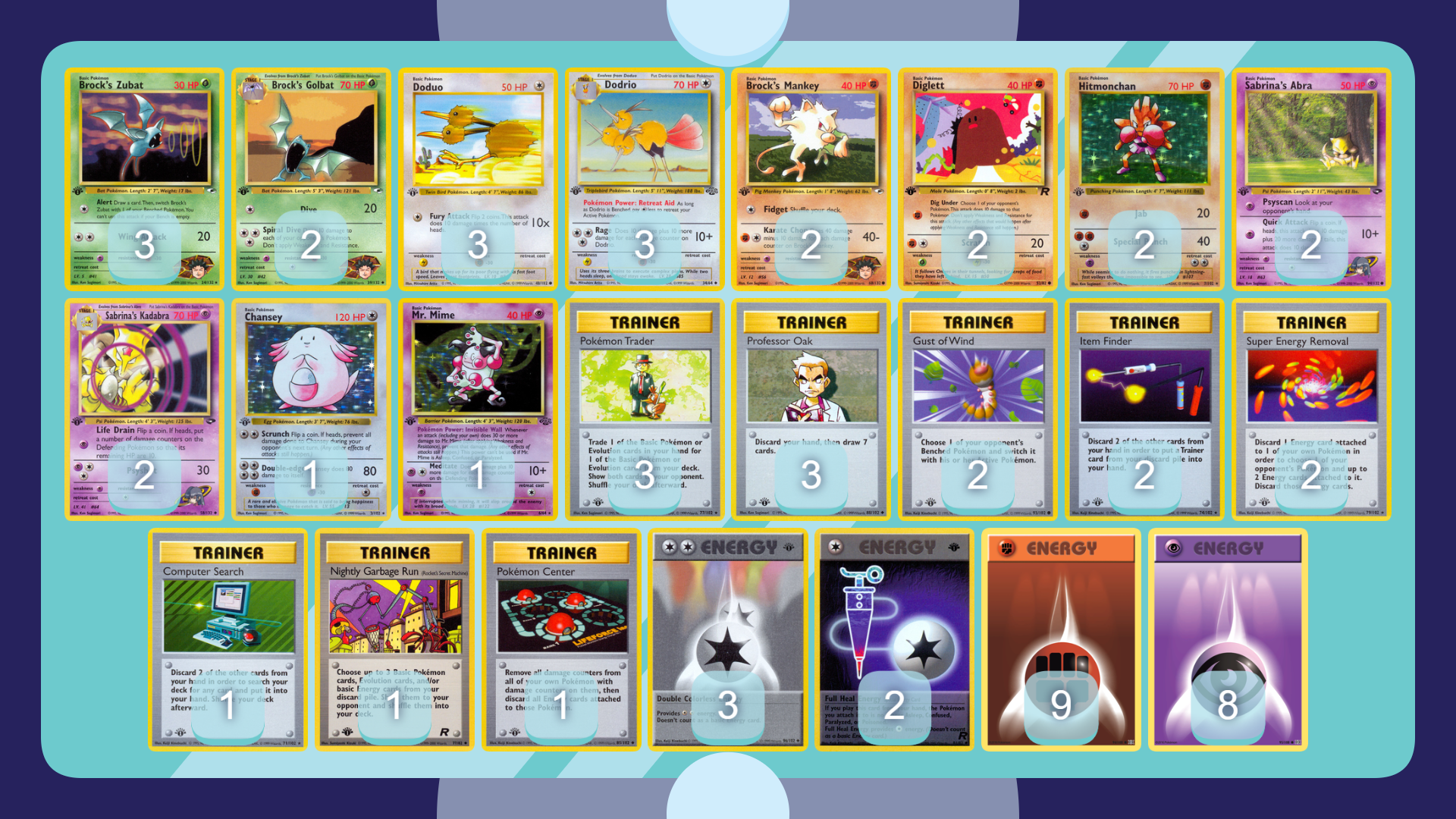
Fighting-Psychic Dodrio Brock’s Golbat Sabrina’s Kadabra
UPDATED 2025.02.01
An attempt to play Sabrina’s Kadabra, this deck can attack many decks for Weakness and threat OHKOs against many popular Pokemon. It also has Pokemon with different types of Resistance to slow down the opponent. I’ve been able to win some against Lightning-Fighting Dodrio Wigglytuff, but I don’t know how much of that is due to luck.
Fire Brock’s Ninetales
UPDATED 2025.01.26
Due to the Brock’s Ninetales losing Shapeshifted Evolutions to status effects, this deck falls apart in many situations. It can fight well against Slowpoke Stall, but Wigglytuff decks are very difficult to beat. I may explore Dark Dragon varieties of this deck.
For more insight on this list (both playing or playing against it) as well as possible cards to play, see the Deck List Details page.
 Retro Trading Card Games